
First Impressions: 6/11/19
Located in Roanoke Valley, Bradley Free Clinic (BFC) was founded in October 1979 with the sentiment of providing free health care to the low-income, working or temporarily unemployed people through the recruitment of volunteers and volunteer health professionals. Over the last 40 years, they’ve served hundreds of patients and firmly continue to provide outpatient care for the community. On my first day, Lauren (my co-intern) and I am led into the front office space and through the building by our volunteer coordinator, Miller. She introduced us to the focused but friendly faces of the staff amid their daily duties: ordering prescriptions, setting appointments, updating patient charts—depending on who you ask. The clinic’s main operations all occur on one level. We passed seven rooms, five smaller patient rooms and two more spacious ones. As the clinic stretched in front of us, we could see that the space was filled with both medical and exercise equipment, tables, chairs, and paint cans, “You can see we’re busting at the seams,” Miller said with a warm chuckle.
This summer, Lauren and I will be working closely together doing various tasks and projects that help the clinic run from its day-to-day activities from filing or scanning charts, organizing supplies, to switching out rooms. We come in everyday starting in the morning. Clinic is on Tuesdays and Thursdays from 5-8pm, and Fridays starting from 8am. These are the moments I particularly look forward to as it will offer an opportunity to interact with patients of community and the physicians. What I find amazing is the range of health care professionals that serve the clinic: people from rheumatology, infectious diseases, dermatology, psychiatry, and podiatry. BFC is not only a medical clinic, but offers a dental clinic as well as a pharmacy. Curious, we asked James, the head pharmacist, how does the clinic stock relevant medications. It’s a combination of donations received from Patient Assistance Programs (PAP) and pharmaceutical companies, where the latter can be able to write their donations off their tax returns.
—
Middle-internship Glimpse
Now nearing the end of my third week, I am very grateful for all the acceptance, patience, and mentorship I’ve received through the staff, physicians, and patients thus far. Lauren and I have been working on several projects throughout our days. One entails navigating the technology of AthenaNet, which is an online medical database of all the patients. The Clinic is currently in this transitional period from paper to computer, so there is often difficulty across the office of using the program and locating certain information. We are in the process of updating the online charts to reflect the physical ones so that the physicians can have “easier” access to the patient’s history of previous visits. I pause to leave “easier” with quotations because some of the doctors prefer to scribe their notes on pen and paper, but it makes the back-office work of interpreting the diagnosis and orders quite time-consuming and frustrating (I’ve had a fair share of scrutinizing over the signature Doctor’s chicken scratch): it often takes three pairs of eyes to decode the nuances of some certain handwriting (name omitted). Within this process, we are hoping to build on BFC’s Women’s Health program by updating online charts with relevant information. This includes redesigning the Women’s Health History paperwork so that it maps on to AthenaNet’s layout. Additionally, we are in the process of designing a manual for a scribe program that will hopefully be introduced within the next year for the Clinic to recruit students that can do the work of documenting doctor’s orders.
—
A Look into the Effect of Job Autonomy on General Health:
Because we receive patients that must qualify within our clinic’s thresholds (138%-250% below the poverty level), many patients are currently working low-income jobs or are unemployed. It is simple to say a job’s environment and hours will affect a person’s outlook, physical body, and paycheck. What becomes more disheartening and frustrating to hear are the experiences of individuals who voice their lack of choice on what terms they get work. For example, a security guard who works night shifts is experiencing difficulty with insomnia, in addition to remembering to take his medications that are to help with diabetes management before they reach dangerous levels. One patient who is employed at McDonald’s, works the later shift from 5pm to 2am. She is a woman battling with obesity and her weight-lost and sighs when the doctor recommends her to incorporate more greens in her diet (likely not the first time she has received this “advice”). She says
“All I want when I get off my shift, is to have warm chicken tenders. I tell myself that they’re no good (for my body). But every time, I reach for them. They help me sleep better.”
Another woman who worked in a factory setting and was asked to leave since she could not stand for long periods of time due to the sudden inflammation in her feet that was painful to walk on. She gave a sad chuckle when the doctor told her swelling was due to overuse and was likely a result for standing so long at her previous job. From work-induced arthritis to skewed sleep schedules, working lower-income jobs inform a person’s liberty of cooking healthy meals, getting consistent exercise and sleep, or feeling content. The providers have been receptive to patient concerns and situations, but prescribing an occupation change is not easy, nor does the clinic have the resources/department to find job opportunities.
—
“Contextualizing the Organization within the City”:
In conversation with a few locals, it’s been said that “Roanoke is a food desert”. This statement kind of surprised me because I hadn’t realize all the privileges I had surrounding my placement in the city that prevented my understanding the city’s infrastructure: I was based downtown—close to a weekly farmer’s market, a food co-op; I had access to my cohort-mate’s car and sense of car-pooling community, and I didn’t need to “worry” about cooking for anyone but myself. Though there are a few Walmarts and Krogers in the general area, one needs a means of transport. For reference, I am seven minutes away by car from the closest Kroger. Though there are some bus routes available, and one could bike to places, there are still disadvantages and a lack of access to healthy food at play.
During one of my check-in Skype-calls with my program, I heard for the first time the term “food apartheid”. Food apartheid takes the essence of a food dessert and asks onlookers to look deeper into the systematic influences that affect a population’s access to food. Roanoke is the kind of city whose streets are busy during the day due to all the people that drive into Roanoke to go to work at big business such as Carilion, LewisGale, Anthem, or Wells Fargo. After around 6 pm, the city clears out, creating an often eerie, quiet feel. Besides the residential buildings that house students from Jefferson’s Health and Science Colleges, there are few apartment complexes. Many of the city’s residents live farther from the city’s center, often from the Roanoke County suburbs. One of the indicators that Roanoke lacks a robust food environment is the amount of Dollar Generals that seem to surround the city (see images below). Convenience stores, though they do stock food stuffs, does not provide fresh produce.
The city has tried to lure a grocer to the low-income area, where the U.S. Department of Agriculture says most urban residents are more than a half mile from the nearest supermarket and most rural residents are more than 10 miles away. (wtop.com)
The characteristics of Roanoke’s history in recognizing the city as a food apartheid can also be argued as racial. Roanoke used to be a railroad-centered industry, which explains its proximity to the tracks, as well as the vintage street art that is an ode to the railroad town nostalgia. When major industry plants shut down, the lack of employment created space for poverty to nestle in the city. This, compounded with Roanoke’s strict segregation during the 1950s, created disparate neighborhoods connected by poverty. These effects can still be seen today: Northwest Roanoke is considered to be the area of the “Black Poor” while Southeast Roanoke contains the “White Poor”. In recent years there has been a push towards bringing in businesses in areas such as Grandin Village and Wasena, areas that also have larger predominance in White and Black populations over the other respectively. Grandin Village has seen more investment and was the first attempt to attract economic opportunity. On the other hand, Wasena, whose voice is becoming louder, is said to be “catching up”. Though this is promising and due in time, It seems that this example hints that there is a factor of race that influences what areas are invested in. (This knowledge was told anecdotally by a co-worker)
While Roanoke is trying to rebuild itself and address its poverty, the gentrification and emphasis on recreation-in-the-outdoors seem like distraction from recruiting businesses that would help the community grow and thrive. Roanoke is an area surrounded by stunning views, ridges, trails, and kayaking spots. It also has a variety of concept breweries and coffee shops. I’m not at all sure what exactly Roanoke could benefit more of in terms of business, but I found it notable that there is lack of public awareness in the social, racial history of Roanoke and its poverty. Rather, when I tell people I’ve been spending my summer in Roanoke, I hear, “Roanoke! I hear it’s beautiful. So many hiking spots!”. Which is true, but I’d be curious to see what the conversation might look like if poverty-issues and race-issues in Roanoke had the same resonance as such matters in cities like D.C., New York, or Chicago. My response? Leading this initial interest in talking about Roanoke’s lovely exterior into a deeper, more critical discussion on what bigger-picture concerns I’ve noticed in Roanoke.
Interesting related readings:
https://wtop.com/virginia/2019/07/residents-of-virginia-food-desert-lose-another-grocery-store/
https://www.100daysinappalachia.com/2017/10/20/poverty-justice-education-roanoke-virginia/
On Race:
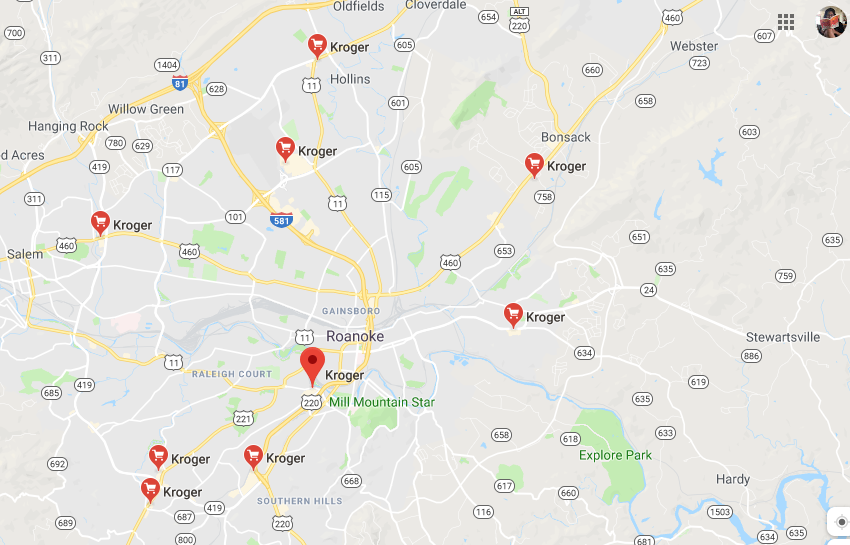
Kroger Locations in Roanoke (8)
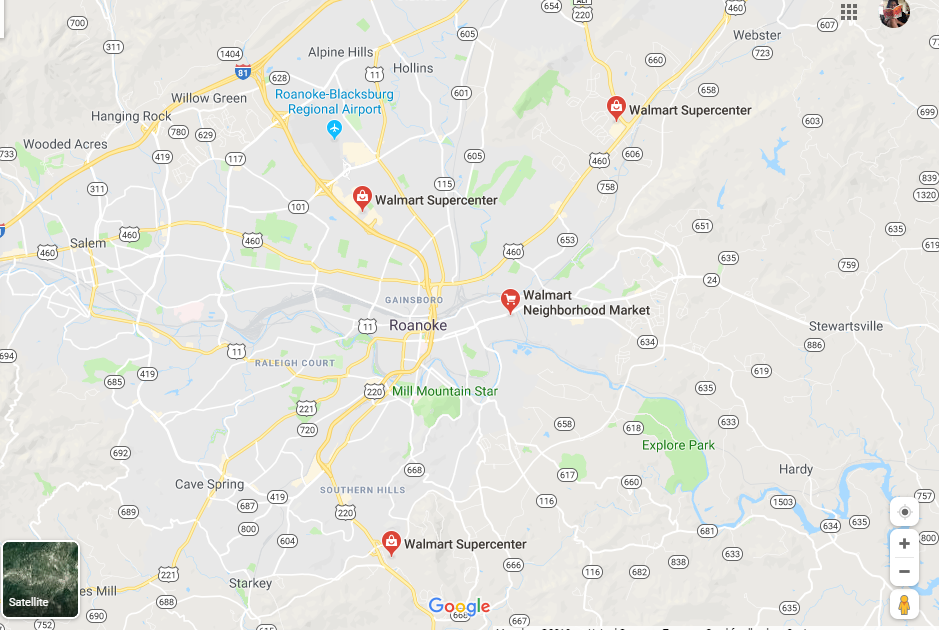
Walmarts in Roanoke (4)
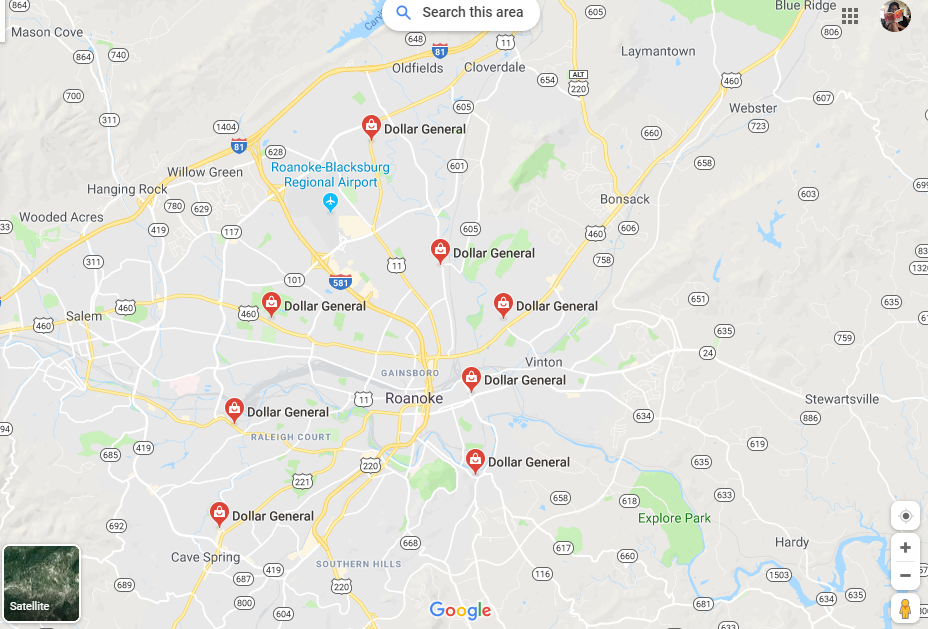
Dollar General Locations (8)